
An Introduction to the Med-Side (Smart Bedside Cabinet)

Kinetic-ID recently launched the Med-Side which support patient Self-Administration of Medication, has garnered a lot of attention in the press, not least the BBC which referenced Kirsty Mair, the mother of a son, Jacob, who has spent the last 16 months in hospital.
“A mother whose son has been in hospital for more than a year has praised trials of a new technology which dispenses medication and has helped her "feel like a mum again.”
Source BBC

So, what is the "Med-Side” and why has there been so much interest in it?
In this short article, we sat down with Wayne Miller, a Solutions Consultant at Kinetic-ID, to hear first-hand what it is and why it has been gaining such attention in the UK.
The Med-Side
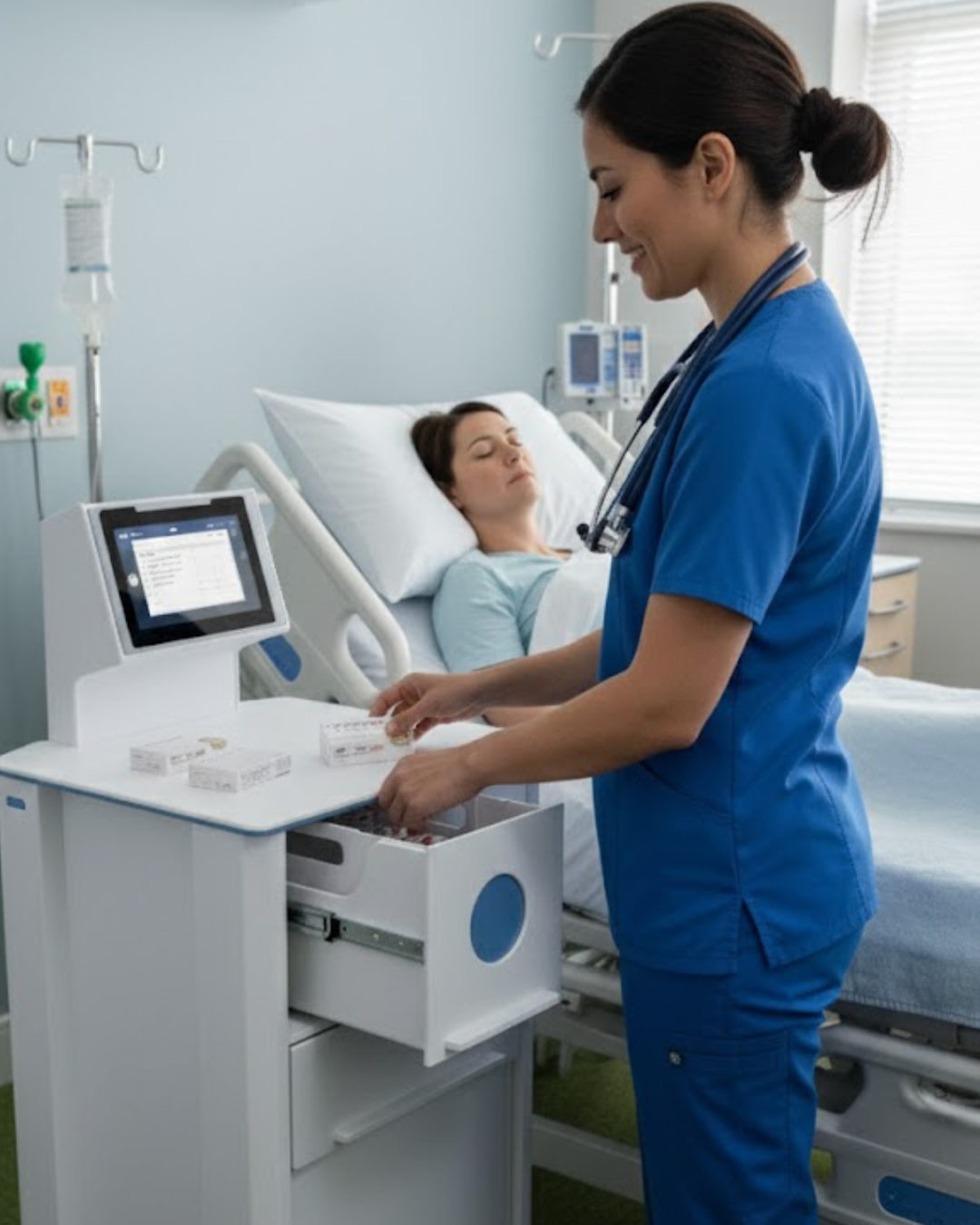
The Med-Side is a self-contained solution that supports patients to self-administer prescribed medications. A patient in a hospital, a care setting, or at home can have a prescription loaded into the bedside cabinet, which then reminds them to take their medication when it is due.
What sets it apart from a standard bedside locker is that it captures what the patient actually does and records that data for clinicians to review later.
Because the cabinet can integrate with healthcare software such as drug databases, EPMA, and EPR systems, this record does not sit in isolation. It feeds the systems clinicians already use, keeping the medication record accurate without asking staff to enter the same information twice.
What are the benefits?
For the Patient, Self-Administration of Medicines (SAM) means continuing to take their own medication while in hospital, a care setting, or at home. Being involved in their medication brings many benefits:
- Stay in control: Feel more involved in your care and improve satisfaction, independence and confidence.
- Learn about your medicines: Understand what you’re taking, including new prescriptions, to stick to your treatment and avoid problems later.
- Prepare for going home: SAM helps patients get ready for discharge and plan any support they will need.
- Avoid losing skills: Patients stay confident about managing medicines after leaving care, rather than being de-skilled by a stay in which everything was done for them.

This mirrors the wider case Kinetic-ID makes for medicines optimization happening at the bedside, not just in the pharmacy: the ward is where habits are formed or lost, and where the data that predicts what happens after discharge is generated.
Bringing Smart Data to Light
Underpinning all of this is a simple clinical reality: the consequences of getting medication timing wrong can be serious.
Take the example of a patient who has been prescribed an antibiotic or painkiller and is scheduled to take one every four hours. If they miss a dose at the right time, they may then be thinking about what to do.
Similarly, if you take your medication late, you probably may need to push the next dose back four hours to stay on schedule.
If you try to take them early, it might be dangerous to take painkillers early.
Providing active data back to healthcare dashboards and systems allows clinicians and systems to stay informed and make the right choice for the patient.
“We're all familiar with pressing a button at the bedside to get the attention of the nurse to come over to tell them that you need some more painkillers. Nurses are very busy people working in a stressful environment. Having the medication at bedside readily available to that patient when they want it, also frees up nursing time.”
— Wayne Miller, Kinetic-ID
In short, there can be significant downstream ramifications resulting from poor patient adherence.
Part of the benefit of the Med-Side and SAM is that the data footprint can help monitor patient activity, so a clinician at any time can go and look at the behaviour of the patient.
- Are they exhibiting good behaviour i.e. taking the right dose at the right time?
- Are they taking them late?
- Are they taking them in the wrong dose?
- Does the behaviour indicate a need for intervention i.e. are they making poor decisions regularly like trying to access drugs early?
This data gives an indication to the clinicians about patient behaviour and any need for further education of the patient, and ultimately, the data from Med-Side assists clinicians in judging whether they are likely to be able to self-medicate safely when they leave the hospital.
Additional Benefits
The value of SAM extends beyond the individual patient to the teams responsible for their care.
The readmissions point is worth sitting with, because the gap between discharge and home is where a great deal of avoidable cost sits. SAM is one of the few interventions that works on that gap while the patient is still on the ward.
Summary
In effect, the Med-Side SAM solution supports medication administration for patients in a safe environment before discharge, helping them learn about their medication — dosages, timings, and the rest — and building good habits that, once formed, increase the odds of them sticking to the process at home. For the ward, it turns medication behaviour into data clinicians can act on, and frees nursing time that would otherwise go on routine bedside requests.
The Med-Side sits alongside Med-Safe in Kinetic-ID's healthcare range: where Med-Safe brings secure, audited storage to the drug round, Med-Side brings it to the bedside and puts suitable patients back in charge of their own routine.
See the Med-Side on your ward
If you are introducing or expanding a Self-Administration of Medication programme, the Med-Side is the secure bedside cabinet built for it: patient-specific storage, wristband, RFID or PIN access, timed prompts, full audit logging, and integration with your EPR, EPMA, and drug database systems. Our solutions team can walk you through how it fits your ward layout, your governance model, and your stepped SAM levels.
Speak with a solutions consultant.jpg)
