
Extend the Life of Your Mobile Workstation Carts with ID-Power

How a DC battery retrofit keeps existing medical carts in service after their original batteries fail, and uses less electricity than the system it replaces.
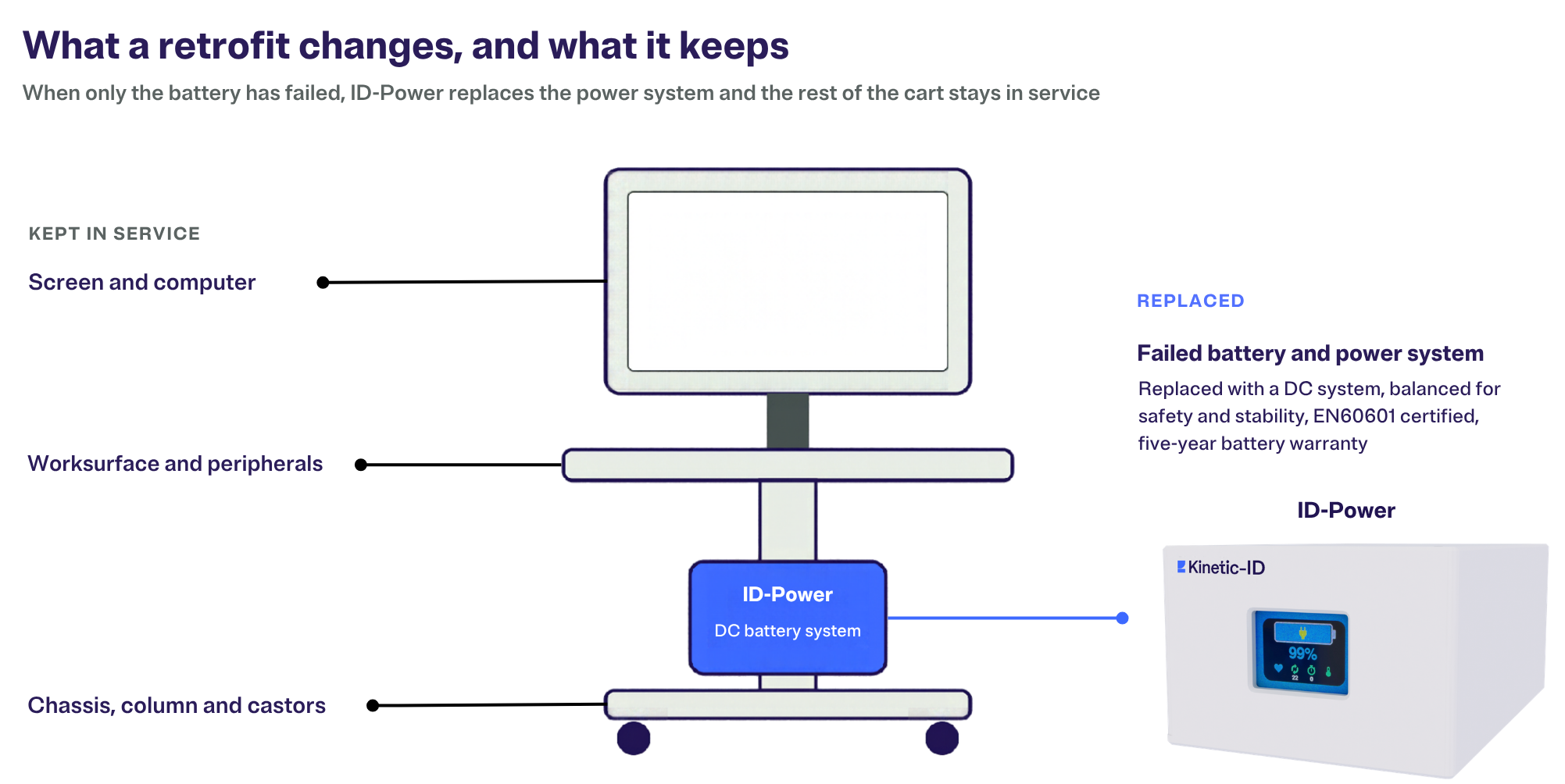
Most hospitals and NHS trusts buy mobile workstations expecting years of service, and many find that the battery gives out long before the rest of the cart does. The screen, the computer, the chassis and the peripherals still work, but a cart that can't hold charge can't leave the wall, which takes away the reason for having it on wheels.
Barnsley Hospital NHS Foundation Trust was one of the first trusts to call us about it. They had bought carts from another supplier 18 months earlier, and those units could no longer hold a charge. That left two options: keeping the carts permanently plugged in or scrapping them, and neither worked for the budget or for the trust's sustainability commitments. ID-Power came out of that conversation.

What ID-Power Is
ID-Power is our retrofit battery system for existing mobile workstations, including carts we didn't supply. We take the same direct current (DC) battery system used in our own medical workstations, adapt it to fit the cart, and balance the installation so the cart stays safe and stable. The electronics are EN60601 certified as medical grade, which means devices powered directly from the system are classed as safe for use in a near-patient environment, and a four-point electronics safety system protects against the battery failures that, in extreme cases, can lead to fires.
Once the retrofit is done, the cart goes back into service fully mobile, and the battery system is covered by a five-year warranty.
Who ID-Power Is For
ID-Power is aimed at NHS trusts and other healthcare providers that:
- bought mobile workstations in the last two years
- are now dealing with battery failure or serious power problems on those carts
- want to avoid the cost and the waste of replacing carts that otherwise still work
For those trusts, the spend goes on the power system the cart needs to keep running, and the rest of the investment stays on the ward.
Why a DC System Uses Less Energy
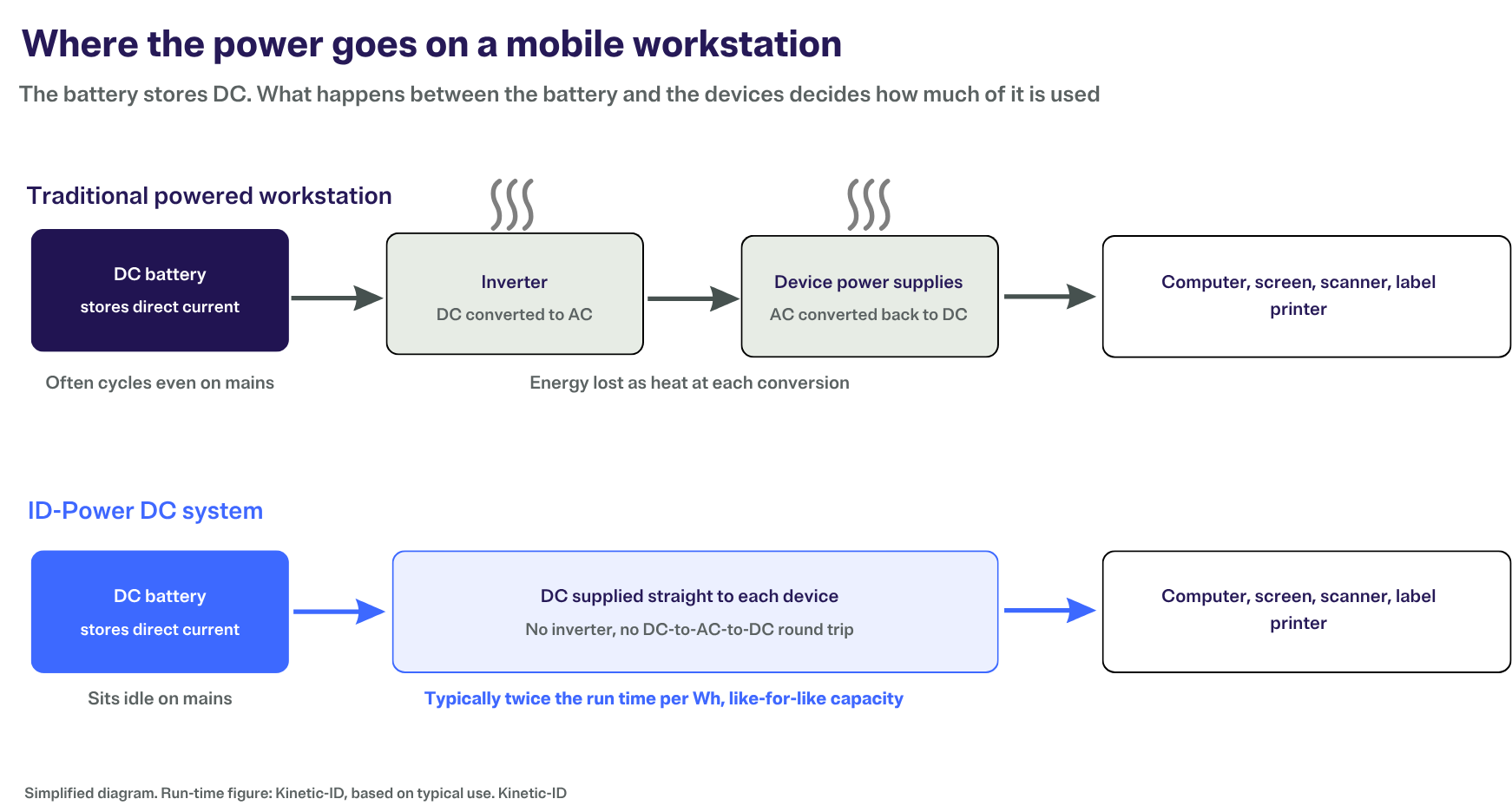
A traditional powered workstation stores energy in a DC battery, runs it through an inverter to produce AC, and then the computer and peripherals convert it back to DC inside their own power supplies. Each conversion loses energy as heat, and many inverter-based systems keep drawing on the battery even when the cart is plugged into mains, adding charge cycles that wear the cells faster. Our guide to medical workstation batteries covers the difference in more detail.
ID-Power has no inverter and supplies DC straight to the devices, so less energy is used both in operation and in charging. On a like-for-like battery capacity it typically delivers twice the run time per Wh of a traditional powered workstation, which roughly halves the electricity needed for the same run time. Overnight, the Eco-Charger system can cut energy use by as much as 90%, the reduction reported in our Croydon Health Services case study. The ID-Power enclosure itself is built from up to 80% recycled plastics, which are fully recyclable.
Retrofit or Replace: Where the Money Goes
A cart that cost thousands is mostly hardware that wears out far more slowly than a battery. When a recently bought fleet fails on power alone, replacing it means writing off working equipment and explaining to finance why carts bought a year or two ago are being scrapped. A retrofit keeps the fleet, puts a DC system with a five-year warranty in place of the one that failed, and lowers the electricity each cart uses from then on.
The retrofit also fits the NHS's own climate commitments. Delivering a Net Zero NHS sets a target of net zero by 2040 for the emissions the NHS controls directly, and by 2045 for the wider footprint it can influence, which includes the supply chain. Keeping equipment the trust already owns in service for longer, and running it on less electricity, works toward both while keeping teams on the ward operational.

What a Retrofit Gives Your Trust
- Lower capital spend, because existing carts stay in service instead of being replaced
- Failed carts back in rotation within days, without waiting on a new procurement round
- Lower running costs from a DC system that avoids inverter losses
- A smaller carbon footprint and less equipment sent for disposal
- A five-year warranty on the battery system
Protecting the Investment You've Already Made
ID-Power is built for trusts that already own carts they're happy with and only need the power system to keep up. It protects that investment and gives frontline teams reliable, mobile access to the clinical systems they use at the bedside, without a full replacement programme to get there. For trusts specifying new carts, the same DC power system runs across our range, including the ID-Flex 3.
If your carts have outlived their batteries, here's how we help
ID-Power replaces failed or outdated batteries in existing mobile workstations, including carts from other suppliers, with Kinetic-ID's EN60601-certified DC power system and a five-year battery warranty. Our solutions team can walk you through compatibility, turnaround times and the retrofit options for your fleet.
Talk to us about retrofitting your workstations →
