
How Intelligent Access Changes the Drug Cart Conversation

The Old Conversation: Does the Lock Work?
When a hospital buys a medication cart, the conversation tends to follow a pattern that hasn't changed much in a long time: how many drawers, what size, whether it fits through the ward doors, and whether the lock works. The cart is assessed as a physical object, a metal box on wheels that holds medicines and locks, and the criteria are size, durability, drawer configuration and a lock reliable enough that staff won't be calling estates at 11pm because they can't get in.
What the cart produces rarely comes into it, because for most medication carts in NHS hospitals the answer is nothing. Staff open it, take what they need and close it, and no record of who opened it, or when, reaches any system. For a long time that was acceptable, because a medication cart was expected to be storage.
The governance around those carts has moved on since. Medicines safety reporting, inspection expectations and trusts' digital strategies all ask for more evidence than they did, while a conventional cart produces the same nothing it always has. We looked at that gap in What Should Your Medication Carts Tell You?, and for most trusts the honest answer is that their carts tell them nothing useful.

What Does “Intelligent Access” Mean?
The phrase is used loosely across MedTech, so it is worth being specific. On a medication cart, intelligent access means three capabilities working together.
The first is individual authentication. Every person who opens a drawer is identified by their own credential, whether an RFID card, an NHS Smartcard or a personal two-factor login, rather than by a shared code that ten people know, so the record shows the named member of the pharmacy team who opened the drawer, not “someone with the PIN”.
The second is per-drawer audit logging. Every drawer access is recorded with the time, the person, the drawer and how long it stayed open, as a digital record created automatically at the moment of access rather than a paper log filled in afterwards.
The third is central management. User access is managed from a central console instead of ward by ward, so IT or pharmacy can add users, revoke access, pull reports and manage the fleet remotely, and when a bank nurse's assignment ends their access is removed centrally, with no code to change on the ward.
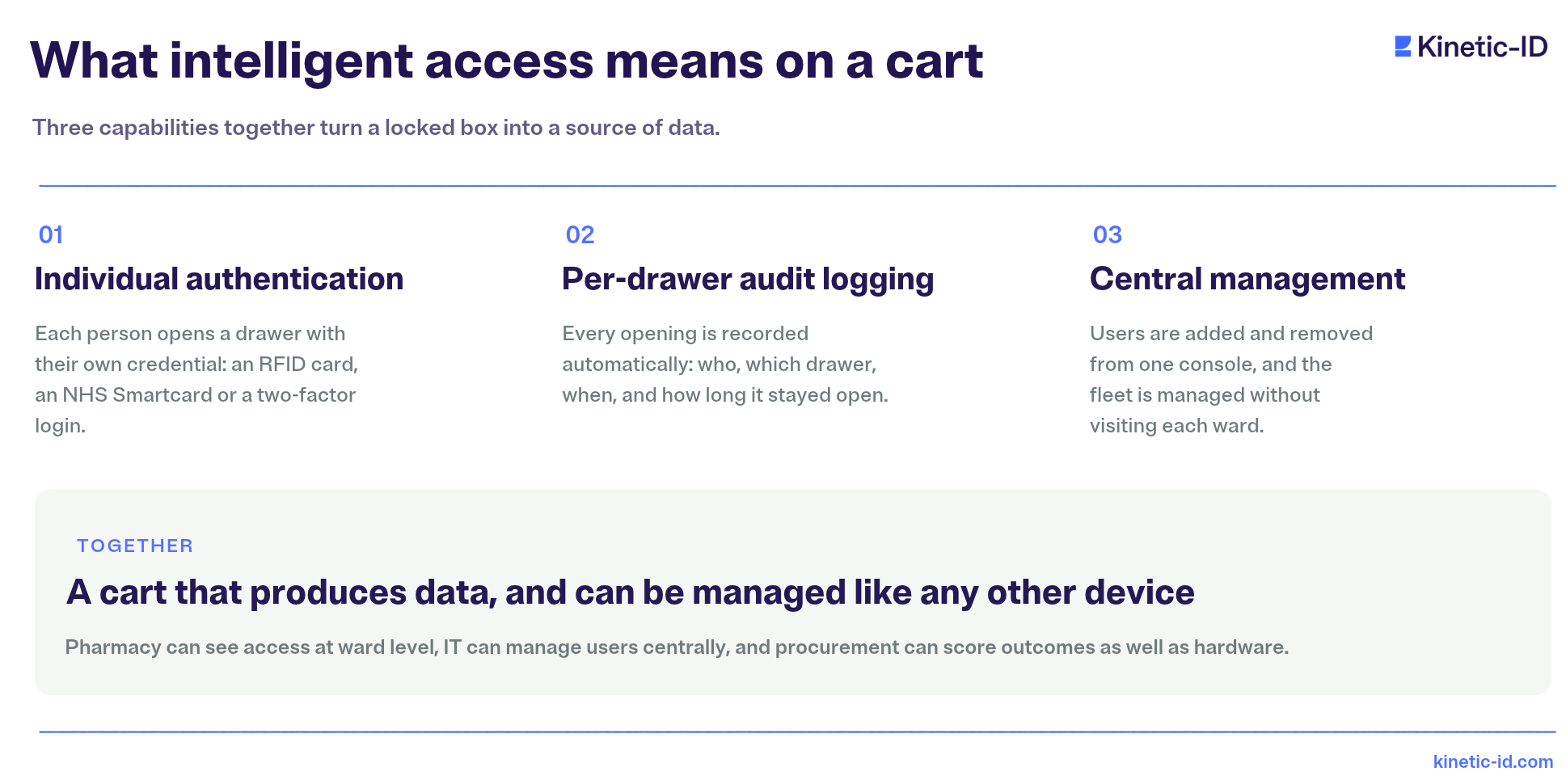
Together those turn the cart into a connected, auditable and manageable device, and that changes what people talk about when they talk about drug carts. The move from shared PINs to individual authentication is covered in more detail in From Shared PINs to Named Access: What Changes for Medication Cart Governance.
The Pharmacy Conversation Changes
Before intelligent access, pharmacy's conversation about medication carts is usually short: are they locked? Pharmacy's visibility tends to stop at dispensing, and what happens at the cart on the ward is treated as a matter for nursing and ward management. With intelligent access, pharmacy gains ward-level visibility of medication access for the first time. A chief pharmacist can see which drawers were opened on Ward 7 at 3am and how long they stayed open, and can spot patterns that point to a process issue, a training need or a handling concern worth looking into.
That matters when the CQC looks at medicines under its Safe key question and governance under Well-led. Asked how medication access is governed at ward level, a trust has traditionally answered with duty rosters and confidence in its processes, and intelligent access adds a searchable, exportable audit trail of every drawer opening. It also changes pharmacy's place in the medication safety conversation, from the team that dispenses to a governance partner with visibility through to the point of administration.
That connects to a wider shift towards medicines optimisation at the bedside, and pharmacy's visibility gap between dispensing and administration is part of the last mile of medication that many trusts have yet to close.
The IT Conversation Changes
In many NHS hospitals, IT teams and medication carts have little to do with each other. IT manages laptops, desktops, phones, tablets and printers remotely, with each device visible on a dashboard and covered by access control policies, patching schedules and asset tracking. A conventional medication cart sits outside all of that: it doesn't connect to the network, it isn't in the asset management system, and when it goes wrong it is usually an estates job.
A cart with individual authentication and central management looks different to IT, because it has users, access policies and logs and can be managed remotely, which makes it a managed device. That matters for IT leaders working through digital transformation. NHS England's What Good Looks Like framework asks trusts to build “smart foundations”, with digital, data and infrastructure operating environments that are reliable, modern, secure, sustainable and resilient, and the 10 Year Health Plan for England (2025) makes the move from analogue to digital one of its three shifts. The medication cart has been a blind spot in that work, and intelligent access brings it into the managed estate.
The practical effect for IT is fewer support calls about shared PINs, fewer out-of-hours calls because someone changed the code without telling the night team, and an end to managing access by word of mouth on the ward, because users are managed centrally like every other device.
The Procurement Conversation Changes
This is where the shift matters most commercially. Medication cart procurement has usually been scored on unit cost, drawer configuration, build quality and warranty, and when a cart reaches end of life the replacement is like-for-like: the same thing, a newer model, the same budget line.
Intelligent access changes what the trust is buying. The cart still stores medication and still has drawers, but it now produces audit data, supports individual authentication and can be managed remotely, which changes the business case. The justification becomes a cart that closes a governance gap, cuts IT support time and produces data that supports inspection readiness, which is a different conversation with the finance team and a different line in the capital plan.
It also changes what procurement compares. Instead of weighing manufacturers on price and drawer size alone, the evaluation asks which options deliver audit capability, user management and remote monitoring alongside the physical product, so the criteria move from hardware specification towards system outcomes. Battery lifecycle belongs in the same calculation, and we covered the hidden costs of hot-swappable batteries separately. With battery status monitored centrally through Kinetic Pulse, procurement is buying a managed fleet that reports on itself rather than a set of carts.
An Upgrade to Equipment Trusts Already Buy
One useful way to think about intelligent access is that it doesn't ask hospitals to buy something they've never bought before. Every hospital already has medication carts and staff already know how to use them, and the workflow stays the same: go to the cart, authenticate, open the drawer, take the medication and close the drawer. The difference is that the cart records what happened, and someone can see that record without being on the ward.
That is why the upgrade framing matters. A trust doesn't need a new budget category, a new clinical workflow or a new training programme, only medication carts that deliver the governance, IT management and audit outcomes it is already being asked for. Med-Safe's tiers make that a stepped change: a trust can start with centrally managed codes on the PIN tier and move to staff-specific access on PRO and integration with NHS authentication on FULL as it is ready.
[CONFIRM] Several NHS hospitals already use Kinetic-ID medication carts with intelligent access hardware, and the software that adds central management, audit reporting and fleet-level visibility is now being rolled out to NHS customers.
For the full product overview, see Med-Safe: Smarter Drug Rounds, Safer Storage. For how cart power fits into continuity planning, see battery management and business continuity.
If your medication carts can't tell you who opened them, here's how we help
Med-Safe replaces the shared code with staff-specific access by 2FA or NHS Smartcard, logs every drawer opening to a named person, and gives IT a live view of the fleet, with battery status reported through Kinetic Pulse. It comes in PIN, PRO and FULL tiers, so a hospital can start with centrally managed codes and move to individual access. Our solutions team can walk you through which tier fits your wards and your IT set-up.
Speak with a solutions consultant →
Frequently Asked Questions
Related reading
- From Shared PINs to Named Access: What Changes for Medication Cart Governance (not yet live; check slug)
- What Should Your Medication Carts Tell You?
- Med-Safe: Smarter Drug Rounds, Safer Storage
- The Last Mile of Medication: From Pharmacy to Patient
- Medicines Optimisation Happens at the Bedside
- Battery Management and Business Continuity
References and sources
1. NHS England, What Good Looks Like framework. Guidance on digital maturity and centrally managed clinical devices.
2. CQC Key Lines of Enquiry, Well-led domain. Expectations around governance of medication access and audit evidence.
3. NHS Long Term Plan (2019). Commitments to digitising clinical workflows and improving medication safety.
4. DCB0129: Clinical Risk Management: its Application in the Manufacture of Health IT Systems. Standard applied to software-enabled medical devices including medication access systems.
5. Royal Pharmaceutical Society, Professional Standards for Hospital Pharmacy Services. Standards on medication governance, safe handling, and audit requirements.
See what your carts could tell you
Med-Safe adds intelligent access to your medication cart fleet. Individual authentication, per-drawer audit logging, and central management. Three tiers. Start where you are.
Book a 20-minute demo with our solutions team.
