
What Procurement Needs to Know About Medication Cart Upgrades

The next time a hospital replaces its drug carts, the decision that matters is whether it is buying a storage device or a connected system that gives pharmacy, nursing and IT something they have never had from a cart: data.
One question rarely gets asked during a medication cart procurement, which is what the cart will tell the hospital once it is on the ward.
The specification usually covers what the cart holds, how many drawers it has and what colour it comes in. It seldom asks what data the cart will produce: what it will tell pharmacy about who accessed medication and when, what it will tell IT about fleet health and battery status, or what it will tell a CQC inspector about medication governance on the ward.
For most cart procurements in the NHS today, nobody asks, because the specification has always centred on the physical object, its dimensions, materials, drawer configuration, weight capacity and price. The cart is bought as furniture and treated as furniture, and it performs like furniture, holding things and telling nobody anything. That is starting to change, and procurement teams are the ones who need to understand why.

Why Is Medication Cart Procurement Different Now?
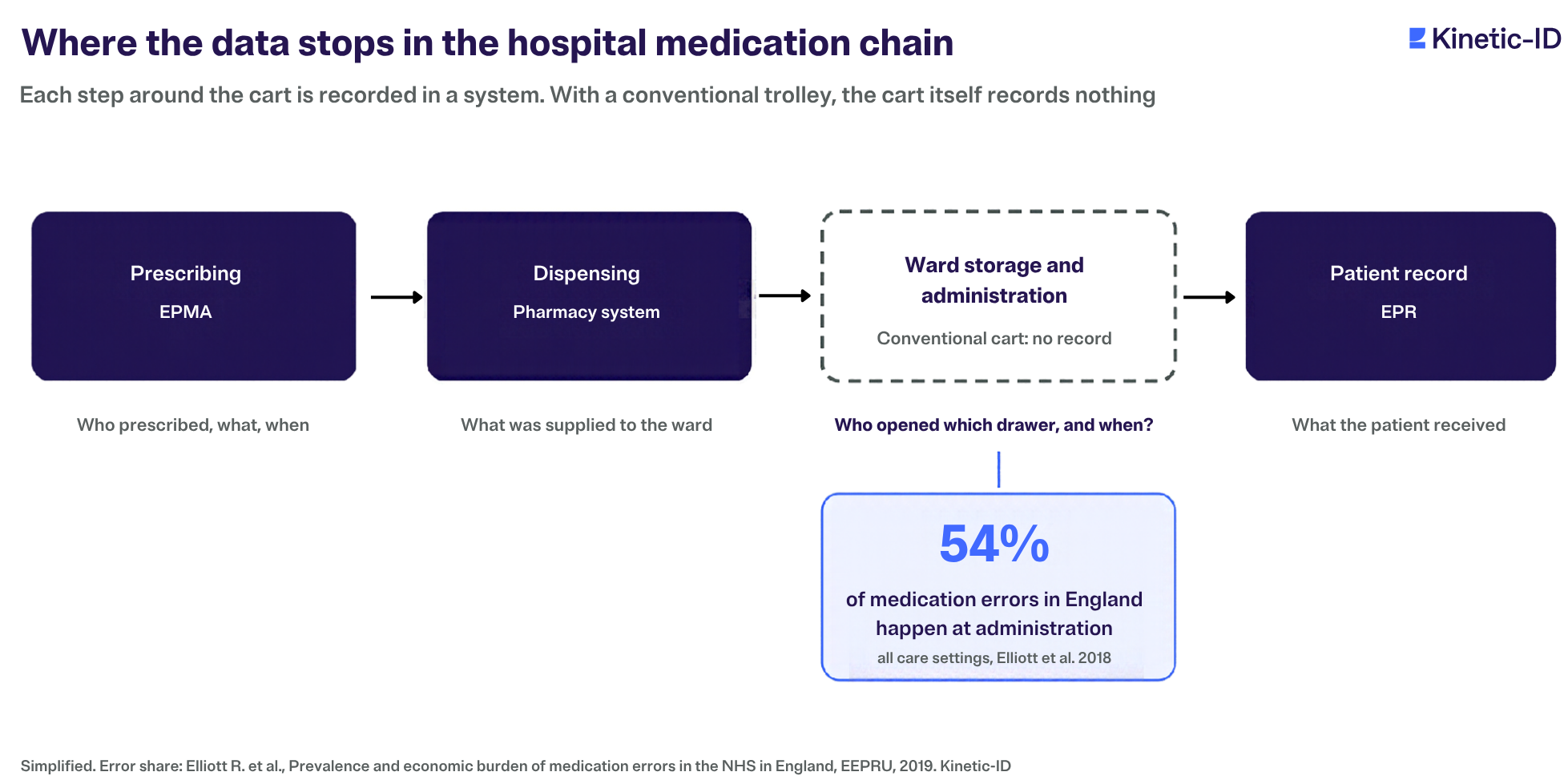
Much of the rest of the medication chain has gone digital. In many hospitals prescribing is now electronic through EPMA, dispensing is tracked through pharmacy systems and the patient record sits in an EPR, so most steps from the prescription being written to the pharmacist preparing the medication are auditable, traceable and connected.
A conventional cart is the step in that chain that produces no data. It sits at the administration stage, which accounts for an estimated 54.4% of medication errors in England across all care settings, according to a 2018 EEPRU report by Elliott and colleagues, and it contributes nothing to governance, audit or the digital record. A national survey of inpatient medication systems by McLeod and colleagues in 2014 found that only 7% of English hospitals used an electronic drug cabinet in any ward area.
When procurement replaces a cart with an identical cart, the gap is replaced along with it, and the question is whether the next replacement cycle is the one where that changes. We look at what a cart could be reporting in What Should Your Medication Carts Tell You?.
What Does the Current Model Cost?
The purchase price is the number procurement sees, but the total cost of ownership is higher, and most of it never appears on the quote.
The wider financial pressure is significant. NHS Business Services Authority figures put the cost of prescribing in hospitals and the community in England at £21.6 billion in 2024/25 before central rebates, up 5.3% on the previous year, and the HFMA notes that after staffing, prescribing is the second largest category of NHS expenditure. The same briefing put the system's savings target for 2025/26 at £11 billion, or 7.1% of expenditure. With pressure on that scale, no area of spend goes unexamined.
Medicines waste is measurable where NHS organisations choose to publish it. NHS Greater Glasgow and Clyde says medicines waste costs it more than £100,000 every day, and Lincolnshire estimates that around 2.1 million medicine items are wasted in the county each year, at a cost of £15.2 million. Both figures relate mostly to medicines dispensed to patients in the community, so they aren't cart figures, but they show how much is at stake, and ward-level waste is rarely published at all.
Some waste is unavoidable, but part of it connects to what happens around the cart: double ordering because ward staff can't see where a delivery is, doses that expire unused because administration wasn't tracked, and stock that can't be accounted for because there is no record of what was accessed and when. A cart that produces no data can't help procurement or pharmacy see where that waste occurs, and a connected cart can.
What Should Procurement Be Asking?
A traditional specification covers the physical product. A modern one adds a different set of questions:
None of these are technical questions. They are questions about value, and the answers separate a trolley that lasts five years from a connected system that supports governance, reduces the load on IT and gives pharmacy visibility it hasn't had before. The shared PIN question on its own has a cost for IT teams, which we look at in why medication cart PIN codes are such a persistent headache for NHS IT.
Why Does This Matter for Procurement Specifically?
Because it creates a new budget category. As Simon Bell, Sales Manager at Kinetic-ID, puts it, medication carts with intelligent access and software connectivity are a different product from a basic lock-and-key trolley and don't sit in the same budget line. Procurement teams need to treat the purchase as an upgrade with measurably different outcomes, not a like-for-like replacement.
That moves the procurement conversation earlier, to the point where the hospital decides what it needs from its next cart fleet rather than the point of signing the purchase order. Involved early, procurement can build the business case for the budget. Brought in at the end, it can only compare prices on a specification, and the cheapest trolley wins.
The financial case itself is straightforward. A connected cart reduces IT support calls, with fewer PIN-related tickets and remote diagnostics in place of ward visits. It gives pharmacy auditable data on medication access, gives nursing leadership visibility of how drug rounds are running, and gives CQC inspectors a digital audit trail in place of a shared PIN code.
Med-Safe is built around that case, with staff-specific access, a tamper-evident audit trail of every drawer opening, EPMA integration and a fleet dashboard for IT. It comes in PIN, PRO and FULL tiers, so a specification can start with centrally managed codes and move to individual access and role-based control. Our introduction to Med-Safe sets out what each tier includes.
What Does a Better Procurement Conversation Look Like?
It starts with deciding what the hospital wants the cart to tell it. If the answer is only that the cart should hold medication securely, a basic trolley will do. If the answer includes governance, audit, accountability, fleet visibility or IT manageability, the specification has to change, and the budget conversation has to happen before the tender goes out.
The context makes the timing matter. The NHS had to find £11 billion of savings in 2025/26, medicines are its second largest cost after staff, and administration is the stage where more than half of medication errors in England occur. A procurement team that buys a cart without asking what data it produces is missing an opportunity that won't come round again until the next replacement cycle, which in Kinetic-ID's experience is typically five to seven years. Better visibility at the bedside also feeds the wider work on medicines optimisation on the ward and on preparing medication well for discharge.
If your next cart fleet needs to do more than hold medication, here's how we help
Med-Safe is Kinetic-ID's connected medication cart. It replaces shared codes with staff-specific access by personal passcode or NHS Smartcard, logs every drawer opening to a named person, integrates with EPMA, and gives IT a live view of the fleet, with battery status reported through Kinetic Pulse. PIN, PRO and FULL tiers let a hospital match the specification to its governance model and budget. Our solutions team can walk procurement, pharmacy and IT through the options before the tender is written.
Speak with a solutions consultant →
Frequently Asked Questions
References
1. NHS Business Services Authority (2025). Prescribing costs in hospitals and the community, England 2024/25. Total cost before central rebates: £21.6 billion. HFMA (2026). Getting better value from spending on medicines.
2. NHS Greater Glasgow and Clyde (2025). Medicines Waste campaign. 'Medicines waste costs NHSGGC £100,000 every day.' Available at: nhsggc.scot
3. Lincolnshire Partnership NHS Trust. Reducing medicines waste. '2.1 million medicine items are wasted in Lincolnshire each year, costing £15.2 million.' Available at: lpft.nhs.uk
4. NHS England. Smartcards and access controls. 'Passcodes should never be shared.' Available at: england.nhs.uk/long-read/smartcards-and-access-controls
5. Berdot, S. et al. (2014). National survey of inpatient medication systems in English NHS hospitals. PMC3943404. Only 7% reported electronic drug cabinets.
This blog draws on NHS financial data, published waste figures from NHS health boards, and NHS England access controls guidance.
Replacing your cart fleet? Start with what it should tell you.
Book a demo with the Kinetic-ID team.
