
MES Implementation in Pharma: Why Point-of-Work Hardware Belongs in the Plan from Day One

An MES implementation in pharma moves batch records off paper and onto a system operators run at the line. Most implementation plans cover the same ground: the software and the vendor or integrator configuring it, the interfaces to ERP, LIMS and the process control layer, the master batch records that have to be authored and verified, the validation work running under all of it, and the training that gets operators ready for go-live. Each of those has a budget line, an owner and a date, and each gets picked over by the steering committee long before anything goes on the floor.
One question tends to arrive later: where, physically, the operator will be standing when the batch record asks for the next entry. It usually comes up when someone walks a suite with a draft master batch record and finds that the step in front of them, a line clearance or an in-process weight check or an equipment log entry, happens several metres from the nearest screen, and sometimes a whole room away. By then the layout is frozen, the network design is signed off, and the validation plan has been written around a list of clients that doesn't include the device the operator will need.
Point-of-work hardware usually gets treated as a procurement line near the end of the project, something to order once the software is ready to run on it. It behaves much more like a design input. Where the screens go decides where power and network have to reach, what enters the cleanroom and how it gets cleaned, what falls inside infrastructure qualification, and whether the first batch on the new system is recorded at the line or carried back to a terminal and typed in afterwards. Each of those is cheaper to settle at scoping than after design freeze, and this post sets out where the hardware decision touches the rollout and what a project team can settle early.

The screen question arrives after the decisions it depends on
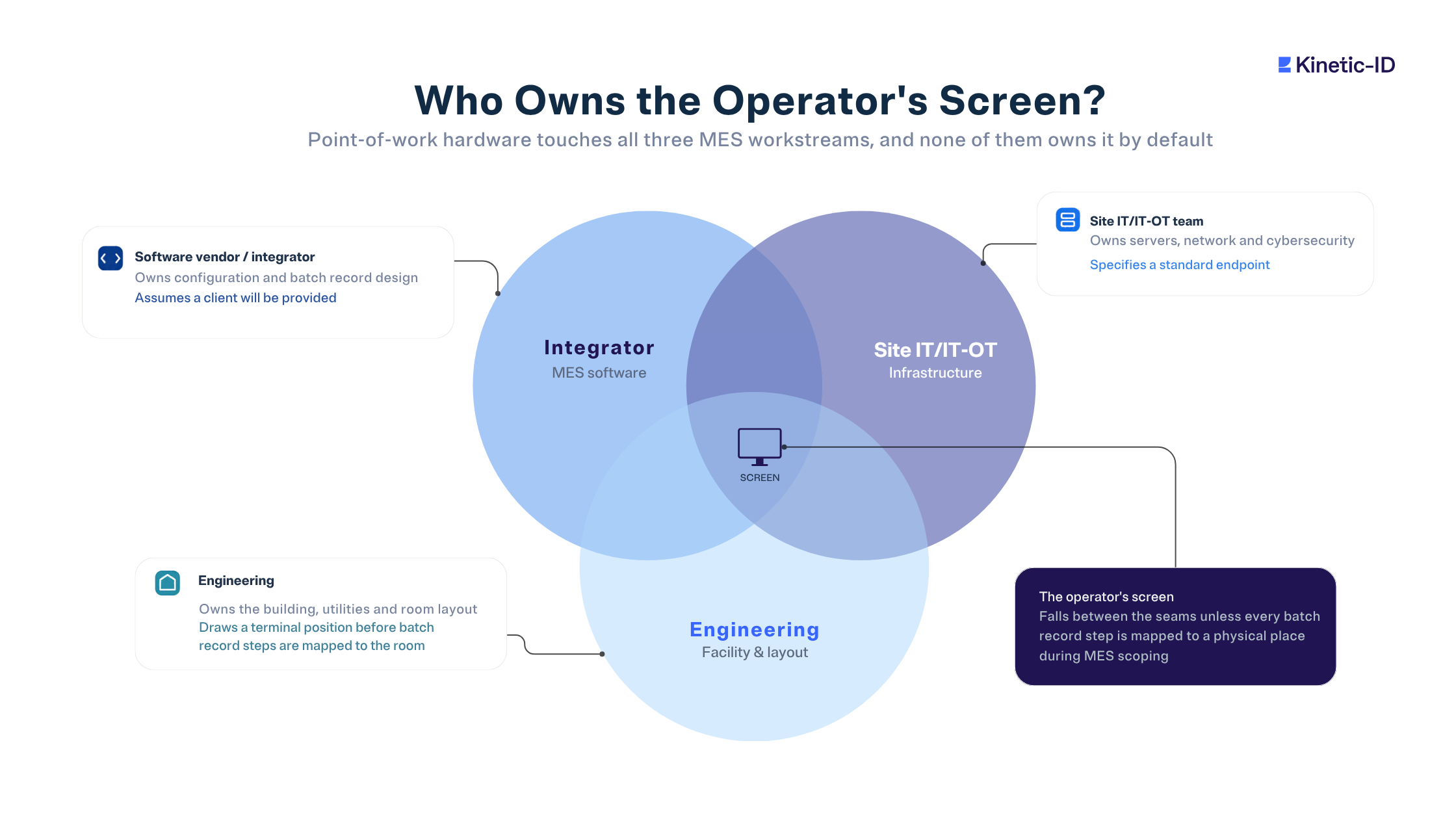
The hardware decision comes late for structural reasons. An MES programme is usually split three ways: the software vendor or integrator owns configuration and batch record design, site IT or the IT/OT team owns servers, network and cybersecurity, and engineering owns the building, the utilities and the room layout.
The device an operator touches at the line sits across all three. The integrator assumes a client will be provided, IT specifies a standard endpoint, and engineering allows for a terminal position that was drawn before anyone mapped batch record steps to places in the room, so the device falls between the seams.
That gap matters because MES projects are already tight on time and cost. BioPhorum's MES of the Future manifesto, published in 2022 by a group of biomanufacturers and suppliers, described current MES solutions as expensive and slow to implement, and lacking the flexibility to be updated and supported efficiently. A hardware decision that surfaces after design freeze adds to both problems, because it reopens drawings, triggers change control on documents that were already approved, and can tie the go-live date to a delivery and qualification schedule nobody planned for.
Where the operator stands is a layout decision
Every step in an electronic batch record happens somewhere. Dispensing happens at the weigh booth, line clearance along the line, in-process checks at the machine, and sampling and equipment logs wherever the equipment is. If the MES is going to capture those steps as they're performed, the project needs a screen within reach of each place, and that requirement runs straight into the facility design.
Power comes first. A fixed HMI needs a supply and a mounting position that suits the wall and the cleaning regime, while a mobile unit needs somewhere to charge or swap batteries, ideally outside the graded area so the charging routine doesn't add traffic to it. Network follows, because a mobile workstation that drops its wireless connection behind an isolator or in the far corner of a suite sends the operator back to a wired terminal.
Then there's the room itself. EU GMP Annex 1 expects exposed cleanroom surfaces to be smooth, impervious and unbroken, requires materials and equipment entering Grade A and B areas to follow a unidirectional, validated transfer process, and expects maintenance to be carried out outside the cleanroom where practicable. A device specified without those requirements in view can end up shut out of the rooms where it was needed most.
Engineering handles all of this for every piece of process equipment, but process equipment is on the drawings from the first layout review and the operator's screen often isn't. ISPE made the wider point in its preview of the 2026 Facilities of the Future Conference, noting that early choices in design, commissioning, automation and digital systems can make or break future inspection readiness. The screen the MES runs on is one of those early choices, even if it's rarely treated as one.
Which locations suit a fixed screen and which suit a mobile one is a workflow question, and we go into it in our comparison of fixed and mobile workstations in life sciences.
How the timing of the hardware decision changes the rollout
Hardware sits inside the validation scope, plan or not
EU GMP Annex 11 defines a computerised system as “a set of software and hardware components which together fulfill certain functionalities,” and its principle splits the work cleanly: the application should be validated, and IT infrastructure should be qualified. It also expects user requirements to be based on documented risk and GMP impact, and an up-to-date inventory of relevant systems to be kept. Annex 15 adds that qualification should consider every stage, from the initial user requirements specification through to end of use, and in the US, 21 CFR 211.68 sets a comparable expectation that computers and related systems used in drug manufacture are routinely checked under a written programme.
For an MES rollout, that puts the shop floor client in the documents that get written first. When the devices operators will use are described in the URS, listed in the inventory and covered in the infrastructure qualification plan from the start, their IQ and OQ run alongside the rest of the infrastructure work. When they're added after those documents are approved, each change goes through change control, the affected documents get revised and re-approved, and qualification of the new clients has to be squeezed into a validation programme that was already full.
Settling the hardware early has a second payoff. A small number of standard client configurations, one mobile unit for processing suites and one fixed HMI for rooms where the screen belongs to the space, can be qualified once and repeated across suites and sites, which keeps the infrastructure effort in proportion as the MES extends past the pilot line. ISPE's GAMP Good Practice Guide: IT Infrastructure Control and Compliance covers that work, and it's far easier to apply to a platform chosen before the rollout than to one assembled from whatever turned up.
The MES decides what the operator records. The hardware plan decides whether they record it where the work happens, and that plan is cheapest to write before the room is built around a terminal in the wrong place.
Go-live is where a late hardware decision shows
MES go-lives in pharma are usually phased, and the first batches often run with the existing paper process alongside the electronic record to limit risk. That period is the first real test of the hardware plan. If the point-of-work devices are installed, qualified and within reach at each step, the electronic record gets completed as the work happens and the parallel paper run can be retired on the evidence. If they aren't, operators finish the step, walk to the nearest terminal and enter the result from memory or from a note, and the MES ends up recording the same transcription it was bought to remove.
That makes late hardware a scheduling risk as well as a data integrity one. Devices have delivery lead times, qualification has to be executed and approved, cleanroom transfer and cleaning procedures have to be written and trained, and charging or battery-swap routines have to be agreed before the first shift relies on them. Start all of that after the software is ready, and the hardware becomes the critical path for a go-live the rest of the programme has already reached.
How operators take to the new devices is a separate risk with its own workstream. The planning point here is simpler: the devices have to be on the floor and qualified before that question can even be asked.
What it looks like in practice
Take a packaging and fill-finish expansion where the MES scope covers electronic batch records for dispensing, line clearance, in-process checks and equipment logs.
At scoping, the project team walks the draft master batch record through the planned layout and marks each step against a physical location. Where the step belongs to a room, such as a fixed control point beside an isolator, they specify a wall-mounted HMI that pivots out for maintenance, so the install doesn't have to be taken apart in the cleanroom. Where the operator moves with the process, from the weigh booth to the line or along a packaging line during clearance, they specify a mobile workstation with a battery that can be swapped or charged outside the graded area.
Those decisions feed straight into the rest of the project. Engineering draws the mounting positions, supplies and charging area into the layout, IT surveys wireless coverage along the routes the mobile units will take, QA reviews materials, finish and transfer route against the contamination control strategy, and validation writes the two client configurations into the URS and the infrastructure qualification plan.
By go-live the devices are qualified, cleaning and charging are part of the SOPs, and the first electronic batch is recorded at the line, which is where the real-time visibility the MES was meant to deliver starts.
.png)
Questions for MES project teams at scoping
For MES project managers, IT/OT integration leads, validation leads and site digital transformation leads, these put point-of-work hardware on the plan while it's still cheap to change:
- Has each master batch record step been mapped to the place where it's performed, and is there a screen within reach of every one?
- Which locations need a fixed screen that belongs to the room, and which need a mobile unit that moves with the operator?
- Are power, mounting points and charging or battery-swap areas on the layout drawings, and outside the graded areas where that's possible?
- Has wireless coverage been surveyed along the routes mobile units will take, including around isolators and large stainless equipment?
- Has QA agreed device materials, cleaning agents and the transfer route into each grade?
- Are the client configurations in the URS, the system inventory and the infrastructure qualification plan, and can the same configuration be repeated at the next suite or site?
- Is hardware delivery and qualification scheduled against the go-live date, or waiting on the software?
Put a number on the hardware decision before the MES budget is fixed
Enter your site's operator headcount, shift pattern, and deviation rate, and get a payback estimate built on your numbers.
Try the ROI calculator
The hardware layer an MES rollout can plan around
Kinetic-ID's Life Sciences workstations are built to be specified at that early stage, because they don't depend on which MES the site chooses. They run MES, EBR, LIMS, SCADA and DCS clients alike, on a Pure DC power architecture, with compute that can be upgraded inside the unit, so the hardware plan can move ahead in parallel with software selection.
For processing suites, the ID-Flow 5 is a single- or dual-screen mobile workstation with the hot-swappable Circadian battery system, rated for Grade A to D, and the ID-Flow 6 adds electronic height adjustment and a fully enclosed stainless build for Grade C and above. Where a process calls for no moving parts, the ID-Flow 9 is a fixed-height 316L stainless unit with vertical dual screens and an internal Pro Durance battery, built for Grade B and high-compliance areas. The ID-View is a wall- or floor-mounted fixed HMI for rooms where the screen belongs to the space, and it pivots outward so maintenance can be done in place. For warehouse, receiving and clean support areas outside the GMP grades, the ID-Flow 3 extends the same MES access beyond the cleanroom.
The floor plan is part of the MES plan
An MES implementation in pharma is judged on what happens at the line: whether each step is recorded where and when it's performed, whether the record can be trusted without reconstruction, and whether the site can extend the system to the next suite without redoing the infrastructure work. The software, the interfaces and the validation all serve that outcome, and so does the screen the operator reads.
Put that screen into the plan at scoping, next to master data and interfaces, and it costs a few workshop hours and some lines on the drawings. Leave it until the room is built, and it tends to cost a change control cycle, a retrofit, and a go-live that starts with transcription.
If point-of-work hardware isn't in your MES project plan yet, here's how we help
Kinetic ID builds GMP-rated workstations for life sciences manufacturing, placed at the line where operators work. Our solutions team can walk you through placement, grade requirements, and deployment configurations for your rollout.
Speak with a solutions consultant
Frequently Asked Questions
References
- European Commission. EudraLex Volume 4, Annex 11: Computerised Systems (2011). https://health.ec.europa.eu/system/files/2016-11/annex11_01-2011_en_0.pdf
- European Commission. EudraLex Volume 4, Annex 1: Manufacture of Sterile Medicinal Products (2022, in force August 2023). https://health.ec.europa.eu/system/files/2022-08/20220825_gmp-an1_en_0.pdf
- European Commission. EudraLex Volume 4, Annex 15: Qualification and Validation (2015). https://health.ec.europa.eu/system/files/2016-11/2015-10_annex15_0.pdf
- U.S. Code of Federal Regulations. 21 CFR 211.68: Automatic, mechanical, and electronic equipment. https://www.ecfr.gov/current/title-21/chapter-I/subchapter-C/part-211/subpart-D/section-211.68
- BioPhorum. MES of the Future Manifesto (2022). https://www.biophorum.com/download/mes-of-the-future-manifesto/
- ISPE. Building Facilities That Think, Adapt, and Endure: Inside the 2026 ISPE Facilities of the Future Conference (iSpeak). https://ispe.org/pharmaceutical-engineering/ispeak/building-facilities-think-adapt-and-endure-inside-2026-ispe
