
Improve Operator Efficiency in Life Sciences Manufacturing Without Rebuilding the Facility

In life sciences manufacturing, improving operator efficiency is usually framed as a capital project. The conversation goes straight to new lines, layout redesigns or more cleanroom space, the kind of change that appears in a strategic plan and needs board approval before anything moves.
For most facilities that option isn't realistic. Once validation, production schedules and cost are factored in, large-scale change becomes hard to justify, especially while the pressure on output, quality and cost per batch keeps climbing.
That leaves a more practical question for operations and site leaders, which is how to get more out of the facility they already have. In most cases the answer has less to do with the environment itself than with how operators interact with the systems inside it.
Most Lost Time Sits Around the Work, Not in It
Operator efficiency rarely breaks down because of one dramatic issue. It erodes through small delays across a shift, the kind that feel minor in the moment and add up to a measurable cost over a month:
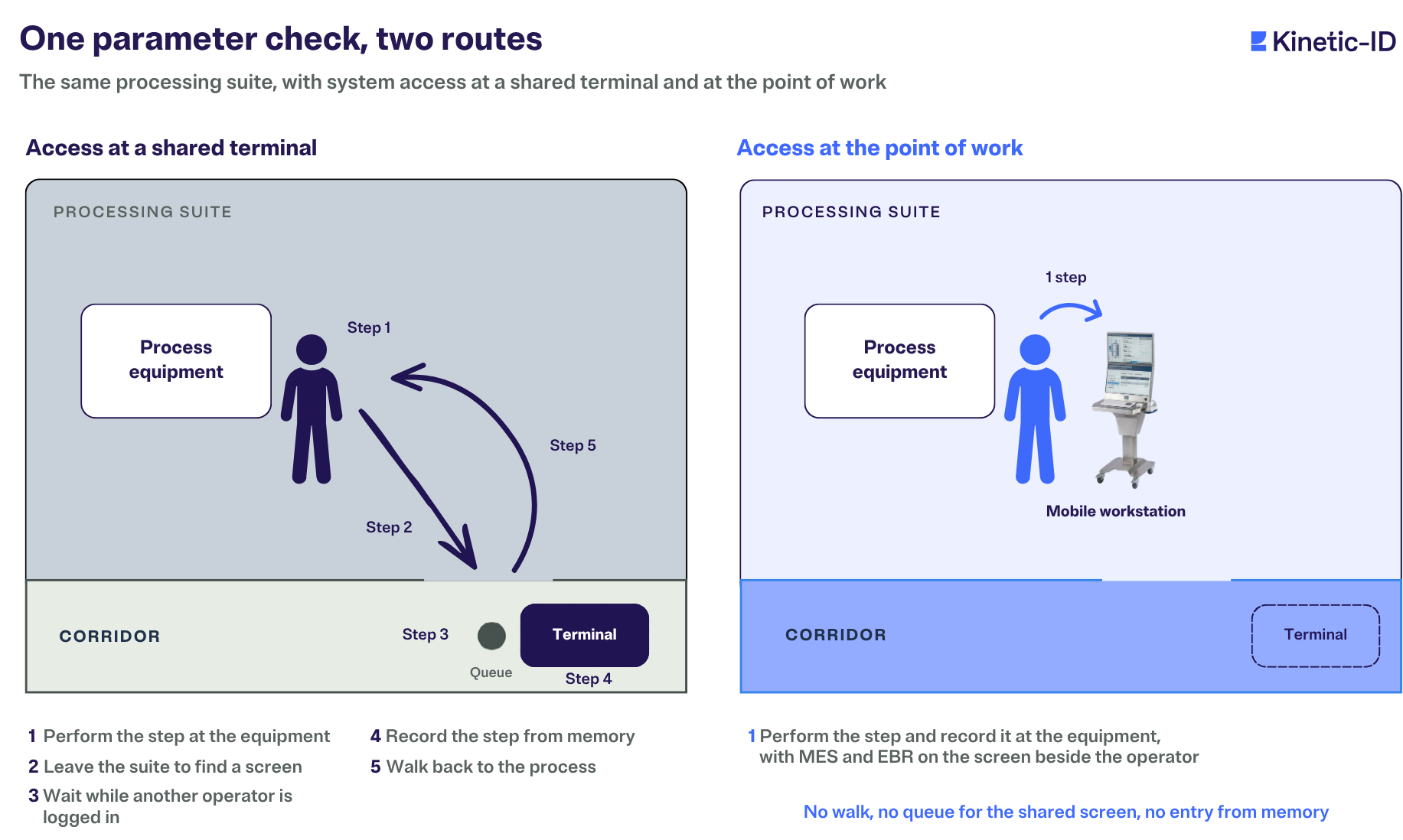
- Walking between assets and terminals to check a batch record.
- Waiting for a shared workstation because someone else is logged in.
- Switching between disconnected systems that don't share data.
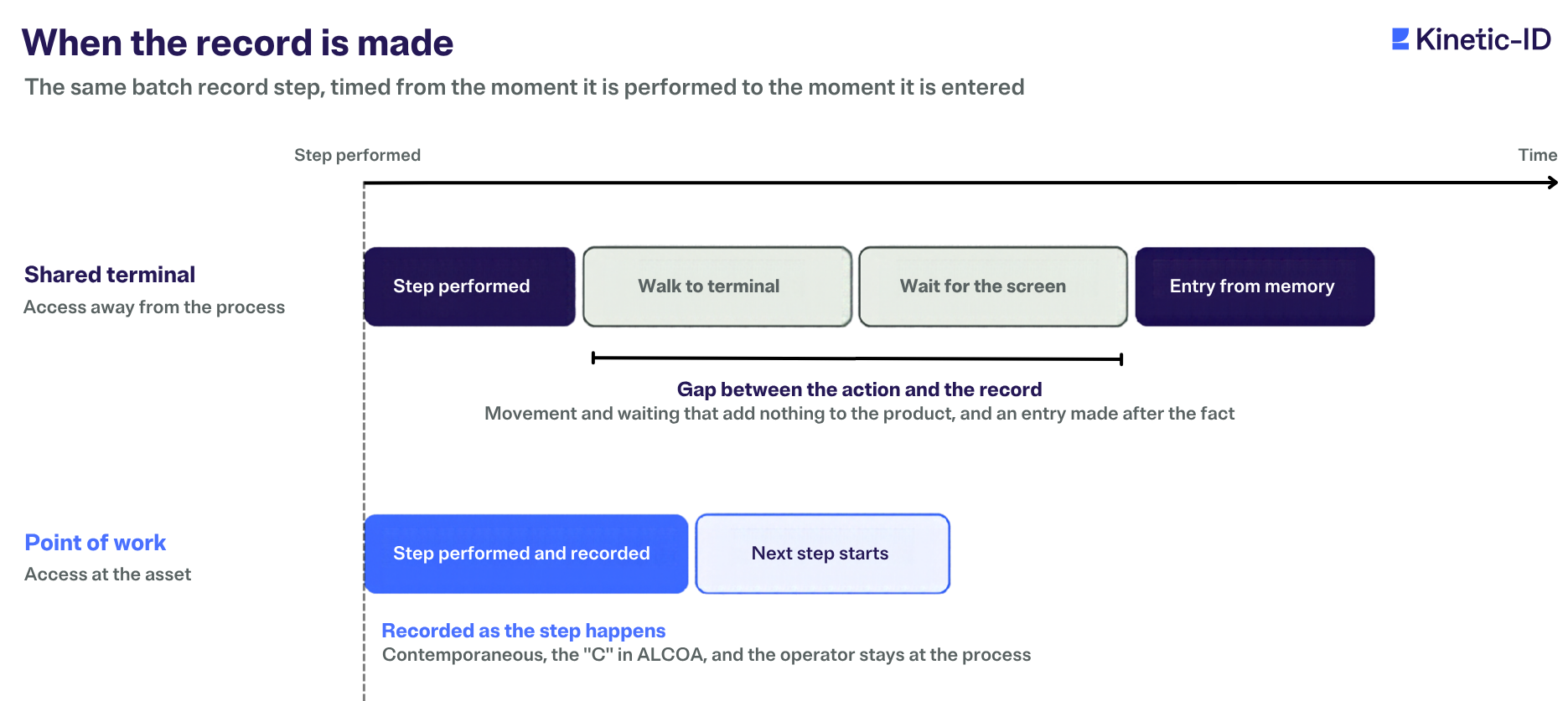
- Going back to document a task once it's finished, from memory rather than as it happened.
- Pausing work to verify data away from the process, because that's where the terminal is.
Lean practice has names for these. Two of the seven wastes listed by the Lean Enterprise Institute are motion, which it describes as operators making unnecessary movements such as looking for parts, tools or documents, and waiting, where operators stand idle while equipment cycles or something they need fails to arrive. Both take time and add nothing the product carries, and the total can surprise experienced teams. When Thrustmaster of Texas mapped its assembly area with a spaghetti chart, the walking needed to get a single tunnel thruster ready to ship came to more than seven miles, close to ten hours of non-value-added time per unit.
Regulated production makes these losses harder to remove, because the workflow has to stay controlled, documented and repeatable, and changing it means change control. That constraint is real, and it is also why the place where operators reach their systems deserves attention, since it is one of the few levers that changes the movement without changing the validated process.
The Constraint Most Teams Overlook Is Access
Digital systems now run most of life sciences manufacturing, with MES for execution, EBR for documentation, DCS and SCADA for control, and LIMS for testing and verification. Most facilities have invested heavily in that infrastructure, yet operator efficiency is still capped by something much plainer, which is where those systems can be reached.
If access sits in a control room, on a handful of fixed terminals or on a screen shared by several operators, performance is limited by physical movement rather than by what the software can do. The data and the tools are there, but every time an operator leaves the line to use them, the site loses production time along with the factory floor visibility the systems were bought to provide.
Movement Is Built Into the Workflow, So It Rarely Gets Counted
One of the clearest signs of lost time is how much of a shift operators spend moving rather than executing. Most facilities underestimate it, because the movement has been part of the workflow for so long that it feels like part of the job.
Movement that could be removed is still worth counting. A short walk to a terminal, repeated every time a parameter needs checking or a step needs recording, becomes a meaningful share of the shift once it is added up across a team and a month, and for a facility chasing throughput targets or a lower cost per batch, that time comes straight out of value-adding work. Here is how those activities compare:
The value sits in one place, real-time interaction at the asset, and nearly everything else in that table is friction.
Improving Efficiency Without Changing the Layout
If rebuilding the facility isn't practical, and for most teams it isn't, the gains have to come from cutting friction inside the layout that already exists. Three levers do that, and none of them involves moving a wall.
1. Bring system access to the point of work
When operators can reach MES, EBR or DCS at the asset, verification and documentation happen during execution and decisions get made without the walk. That cuts movement, improves the accuracy of the record and shortens cycle time, particularly when the workstation strategy is matched to the environment instead of being added as an afterthought.
2. Reduce dependency on shared access points
Shared infrastructure creates predictable bottlenecks. Even a well-planned deployment builds queues when device-to-operator ratios are too low, when workflows overlap across shifts, or when high-activity areas depend on a few fixed stations. The fix is usually more access density where the work concentrates rather than more systems, and it raises its own questions about who owns and cleans a shared device, which we cover in our piece on shared equipment in GMP environments.
3. Make the device layer reliable
Faster access helps only if the device lasts the shift. When a workstation fails or runs out of power mid-shift, workflows stall, documentation is delayed and operators fall back on workarounds, which is where gaps in the record start. Infrastructure that holds up, including battery systems that can be swapped without powering the unit down, keeps the workflow predictable and takes load off the operator.
What Changes When Access Improves
The effect of better access shows up in shift-level metrics, which means teams can measure it rather than take it on trust.
Those changes feed into throughput, deviation rates, audit readiness and operator workload, and together they move a site from dealing with problems after the fact to controlling the process while it runs.
Why This Matters More in Life Sciences
In most industries, lost time is a cost problem, where margin slips and targets are missed but the product still ships. In life sciences, it is also a compliance problem.
Delayed documentation, missed checks and retrospective entry slow production, and they can also affect batch integrity, audit outcomes and regulatory confidence. The U.S. Food and Drug Administration expects data to be attributable, legible, contemporaneously recorded, original or a true copy, and accurate, the principles known as ALCOA. The MHRA's GxP data integrity guidance says computerised systems should ensure the execution of critical steps is recorded contemporaneously, and treats ALCOA+ (which adds complete, consistent, enduring and available) as carrying the same expectations. In Europe, EU GMP Annex 11 expects systems to record the identity of the operator entering or changing data, along with the date and time.
A step entered at a terminal some time after it was performed, from memory, is the kind of record those principles are written to prevent, so improving the way operators interact with systems strengthens the record as well as the output. Peter Cullen describes this as compliance being managed by design and by operation: the validated process is one half, and the conditions under which operators carry it out are the other.
Infrastructure Is Part of the Efficiency Strategy
Most digital transformation strategies focus on the software layer, but operator performance depends just as much on how that software is reached. In practice that means:
- Adding cleanroom-ready access points in the areas where operators currently leave the process to find a screen
- Introducing GMP-compliant mobile workstations where the work moves
- Using fixed HMIs where the work stays in one place
- Matching the access layer to the process flow, step by step
Which steps suit a mobile unit and which suit a fixed screen is a workflow question, and we go into it in our comparison of fixed and mobile workstations in life sciences.
Kinetic-ID's Life Sciences range is built around that split. The ID-Flow 5 is a single- or dual-screen mobile workstation with the hot-swappable Circadian battery system, rated for Grade A to D, the ID-Flow 6 adds electronic height adjustment and a fully enclosed stainless build for Grade C and above, and the ID-Flow 9 is a fixed-height 316L stainless unit with no moving parts for Grade B and high-compliance areas. Where the screen belongs to the room, the ID-View fixed HMI mounts on the wall or a floor stand and pivots out for in-room maintenance. All of them run MES, EBR, DCS, SCADA and LIMS clients, whichever system the site uses.
When to Invest and When to Adapt
Not every facility needs new infrastructure everywhere, and adding it everywhere would be wasteful and disruptive. The highest return usually comes from targeting specific areas: high-traffic process zones, bottleneck workflows, QA-heavy stages and multi-operator zones where contention for screens shows up most.
Targeting those areas lets teams improve performance without reworking the validated layout. New devices still go through qualification and change control, since EU GMP Annex 11 expects IT infrastructure to be qualified, but qualifying a defined set of workstations is a far smaller exercise than requalifying a redesigned suite, and a configuration qualified once can be repeated across areas. The facility stays as it is and gets more out of every shift.
Put a number on the time your operators spend getting to a screen
Across regulated environments, ID-Flow workstations have delivered 20% higher uptime across units, and one customer reported 9% time saved in daily operator activity.
Try the ROI calculator
Where the Gains Become Sustainable
Improving operator efficiency in life sciences manufacturing rarely depends on changing the facility, and far more often depends on changing how operators reach the systems inside it. When access lines up with the workflow, movement drops, decisions happen sooner, errors are caught earlier and output improves without adding complexity. That kind of gain tends to last, because it is built into the infrastructure instead of resting on extra effort from the team on every shift.
If you want to cut operator movement without disrupting your facility, here's how we help
Kinetic ID builds GMP-rated workstations for life sciences manufacturing, placed at the line where operators work. Our solutions team can walk you through placement, grade requirements, and deployment configurations for your rollout.
Speak with a solutions consultant
Frequently Asked Questions
References
- Lean Enterprise Institute. What are the 7 Wastes in Lean? https://www.lean.org/lexicon-terms/seven-wastes/
- Lean Enterprise Institute, The Lean Post. Small Chart, Big Impact: How a Simple Spaghetti Chart Led to Huge Wins at Thrustmaster of Texas (February 2016). https://www.lean.org/the-lean-post/articles/small-chart-big-impact-how-a-simple-spaghetti-chart-led-to-huge-wins-at-thrustmaster-of-texas/
- U.S. Food and Drug Administration. Data Integrity and Compliance With Drug CGMP: Questions and Answers. Guidance for Industry (December 2018). https://www.fda.gov/regulatory-information/search-fda-guidance-documents/data-integrity-and-compliance-drug-cgmp-questions-and-answers
- Medicines and Healthcare products Regulatory Agency (MHRA). ‘GXP’ Data Integrity Guidance and Definitions, Revision 1 (March 2018). https://assets.publishing.service.gov.uk/government/uploads/system/uploads/attachment_data/file/687246/MHRA_GxP_data_integrity_guide_March_edited_Final.pdf
- European Commission. EudraLex Volume 4, Annex 11: Computerised Systems (2011). https://health.ec.europa.eu/system/files/2016-11/annex11_01-2011_en_0.pdf
